34.4million tonnes / year
Municipal waste generated
Of 34.4 Mt generated in 2024, 32.3 Mt was collected and roughly 2.1 Mt was never collected at all.
TÜİK / Ministry of Environment data platform · 2024Atikova is a food-waste management system: we collect restaurant kitchen waste separately, measure it, and take it to compost, biogas or recycling.
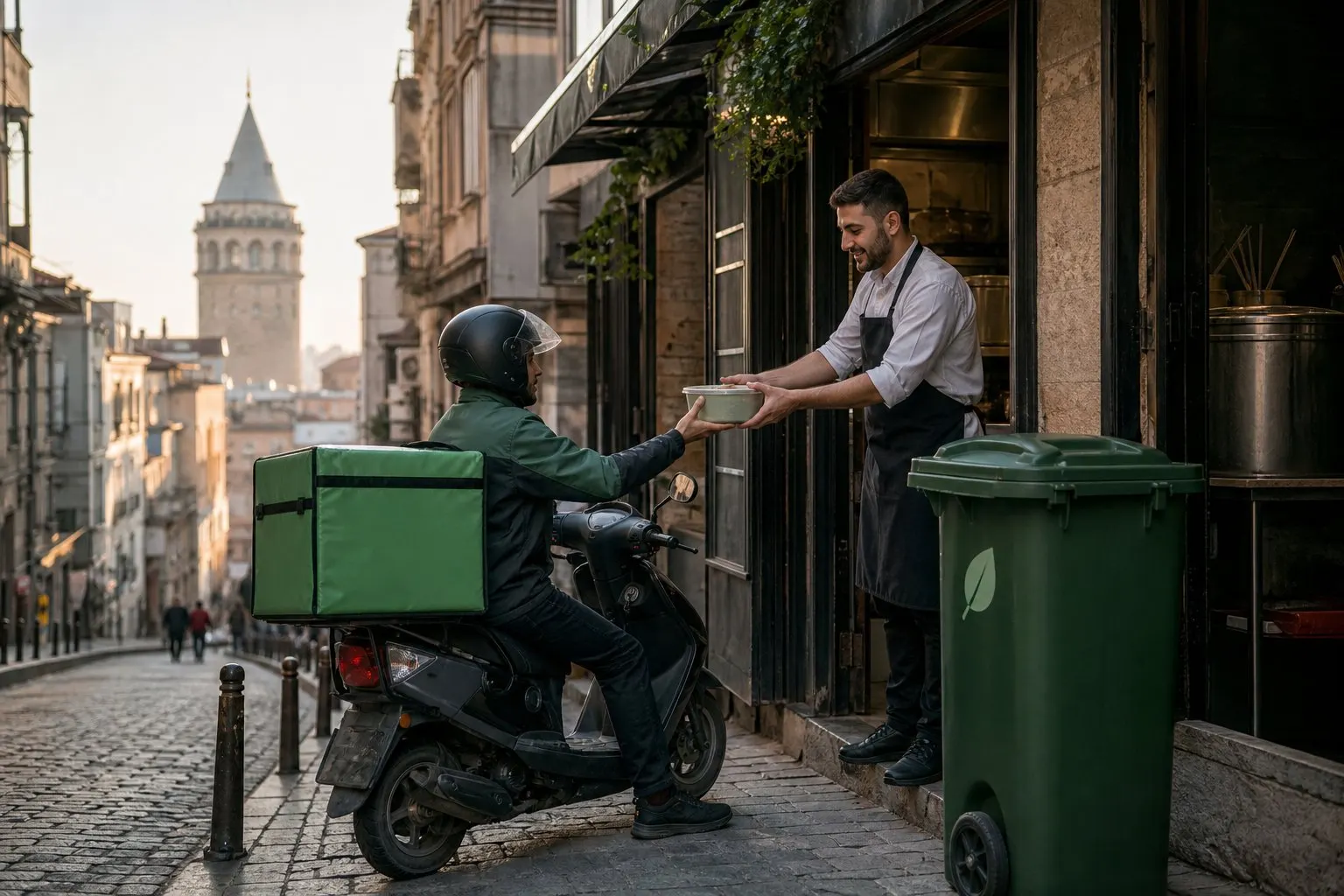
Pilot stage in Istanbul — the app and the motorcycle planner work; no restaurant has joined yet.
Not every resource fits neatly into today’s recovery systems. Organic waste that can’t be redistributed still carries potential — if we understand it, value it, and connect it to the right next step.
Atikova proposes a smarter way to bridge waste data, energy potential and practical recovery decisions.
Experience the platformInvestor video
The problem, the solution, where we honestly stand, and what comes next. With voice-over (AI voice in English, Turkish or Persian) and subtitles — turn the sound on.
About 18,000 tonnes of household waste a day, roughly half of it organic — and almost none collected separately. Every city has its own structure, so each needs its own policy mix. Researched with AI agents; every figure links to a public source.
No financial figures in the videos. Every number on screen names its source; images are AI illustrations and the voice is AI-generated. Not an offer of securities.
Fifteen slides: the problem, the solution, where we stand today, the model, the plan and every source. Follows the language chosen above.
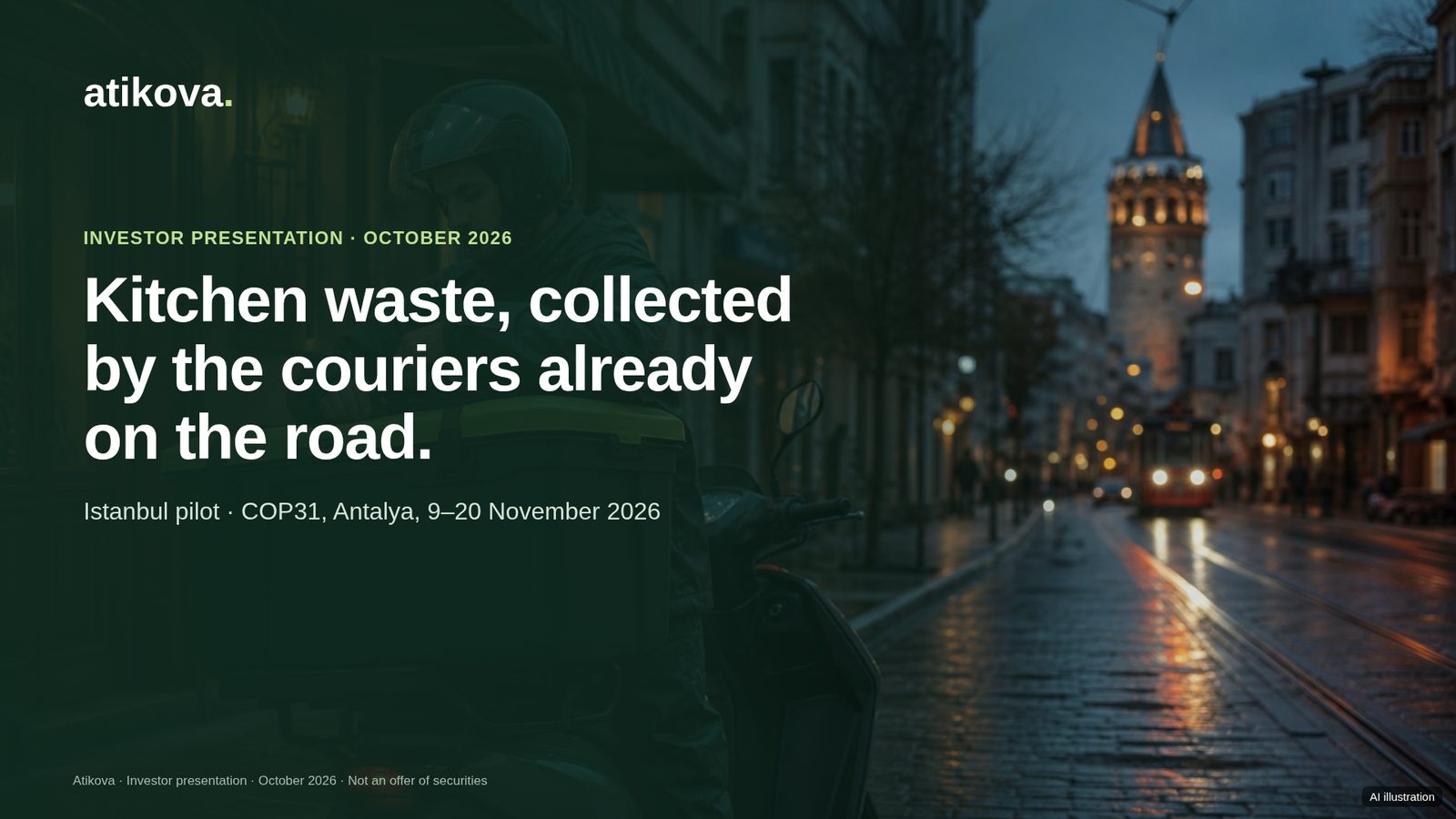
1 / 15 Kitchen waste, collected by the couriers already on the road.
This presentation is not an offer to sell or a solicitation to buy securities.
The country generates 34.4 million tonnes of municipal waste a year. Roughly four fifths of it still goes into the ground, and around half of that waste is organic — the exact material that could become energy, compost and soil instead of methane.
Of 34.4 Mt generated in 2024, 32.3 Mt was collected and roughly 2.1 Mt was never collected at all.
TÜİK / Ministry of Environment data platform · 2024Türkiye's landfill rate has stagnated at a very high level since around 2018, against an EU-27 average of roughly a quarter.
European Environment Agency · 2021The organic fraction dominates municipal waste, yet there is no or very limited composting and anaerobic digestion of municipal waste in the country.
European Environment Agency · 2025Real progress from the Zero Waste programme, but the official target is 60% by 2035 — and the 2021 figure counted only about 12% of generated waste.
European Environment Agency · 2024Only eight biological waste treatment facilities and six mechanical-biological pre-treatment plants serve the whole country.
Avrupa Bilim ve Teknoloji Dergisi (EJOSAT) · 2018Only about 6% of Türkiye's plastic waste is recycled; roughly 1.1 Mt leaks into nature each year.
WWF-Türkiye · 201993.9% of municipal waste is collected. The gap opens afterwards: 81% is landfilled while recycling of generated waste sits near a third.
Only eight biological treatment plants serve the entire country, and anaerobic digestion of municipal waste is negligible.
Figures are survey-based and reported with a lag, and reporting discrepancies make firm conclusions difficult — so capital waits.
That is the gap Atikova exists to close: measurable organic-waste recovery, starting where the tonnage and the infrastructure already are.
Eighty-one provinces, drawn from TÜİK's own population and collection figures. Click a province to read what its bin holds — and where the food in it ends up.
This is a model, not a measurement of every province. Population is TÜİK 2025; the per-capita rates are TÜİK's own measured figures, applied to the province or to its region; the organic share is the measured 46 to 55 percent band reported for Türkiye. The provinces sum to the 34.4 million tonnes this site cites nationally.
Select a province. The ten biggest are below.
50% · measured: 13 / 81
Model, not census: 13 provinces carry a rate TÜİK measured directly, the rest inherit their region's measured rate. The method and all 81 provinces
Atikova Collect is a two-sided dispatch market: a household, a shop or a caretaker posts a pickup, and a collector takes it — a motorcycle courier for the small and quick, a van or truck for the heavy and bulky. It is live, and it is honest about its gaps: no payments, no live tracking, no licence checks.
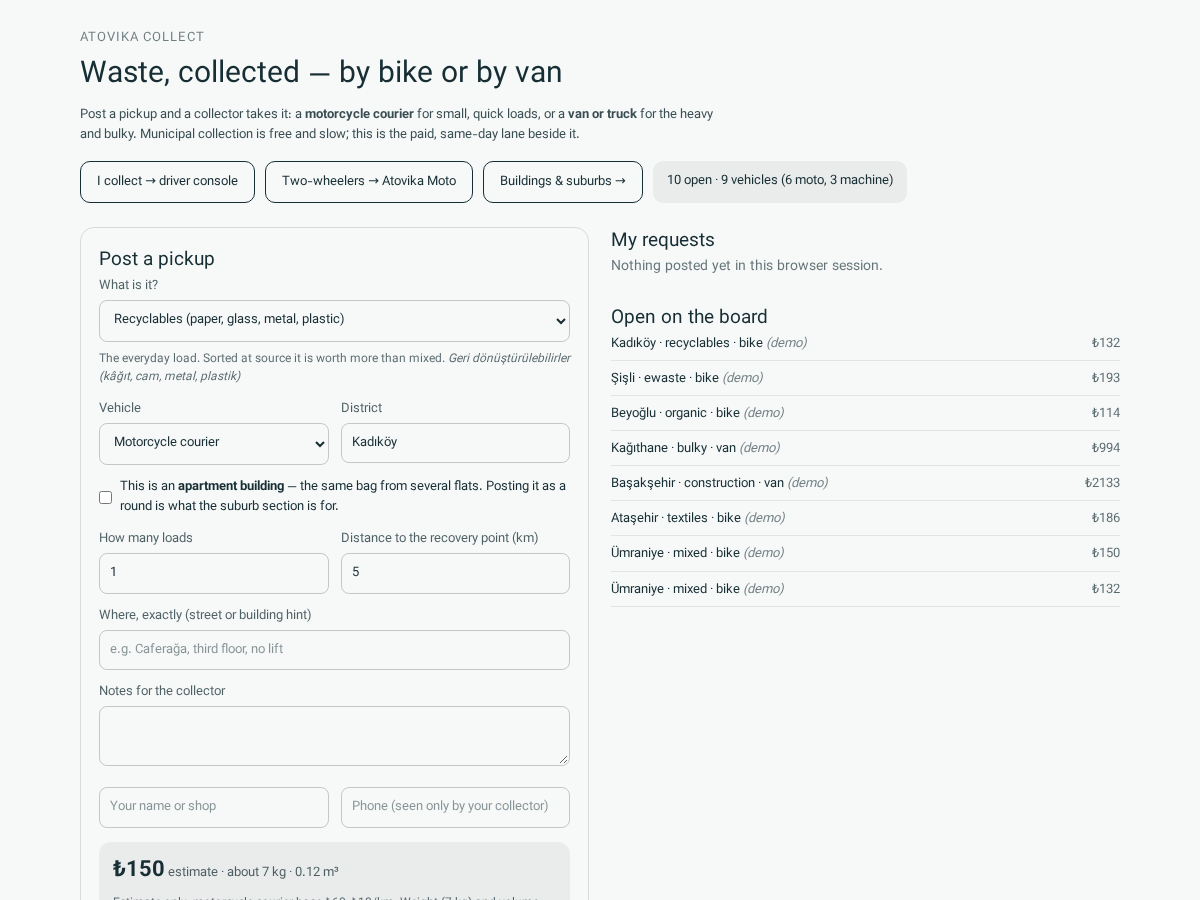 Post a pickupA fare estimate that states its assumptions: base, distance, volume, and what the chosen vehicle can actually carry.Open the request app
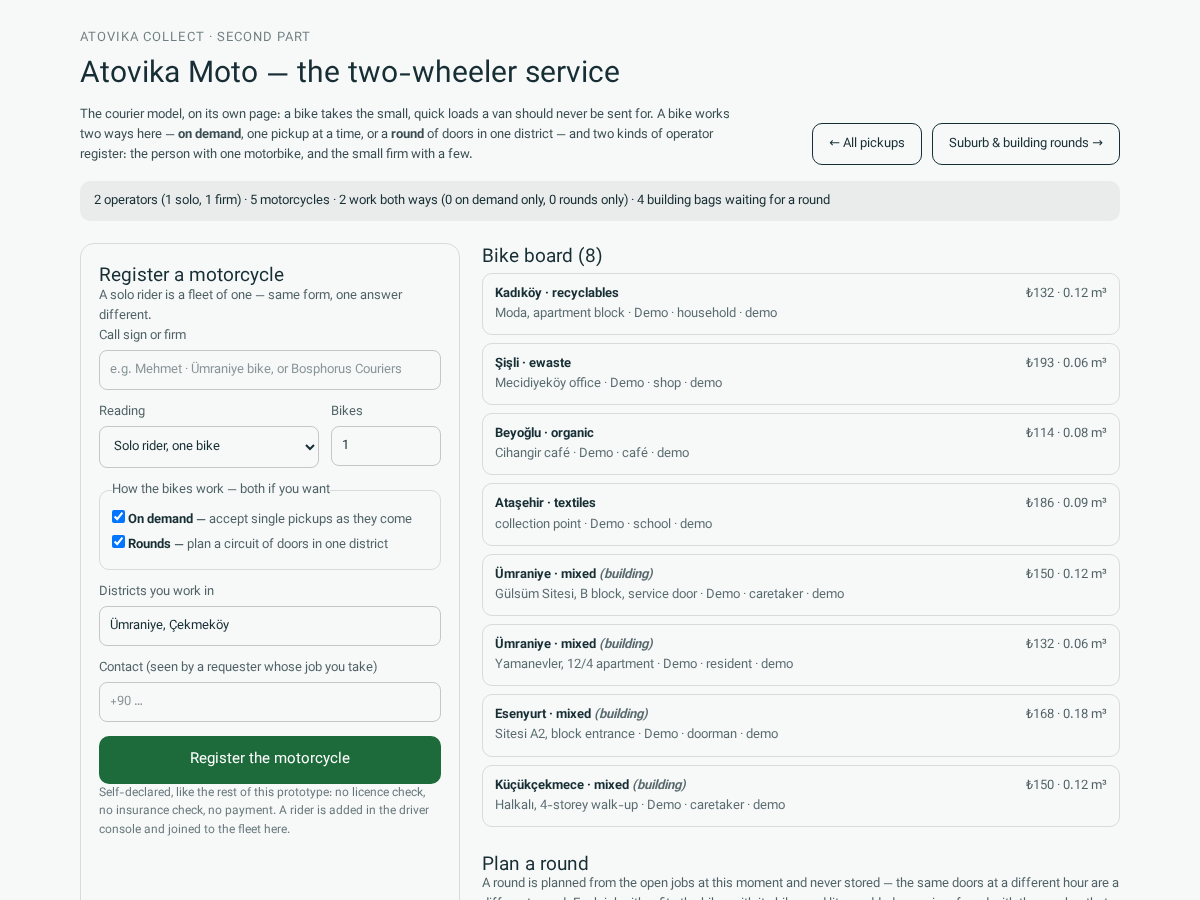 Atikova MotoThe two-wheeler service: on-demand pickups, or a planned round of doors in one district, packed per bike.Open the bike board
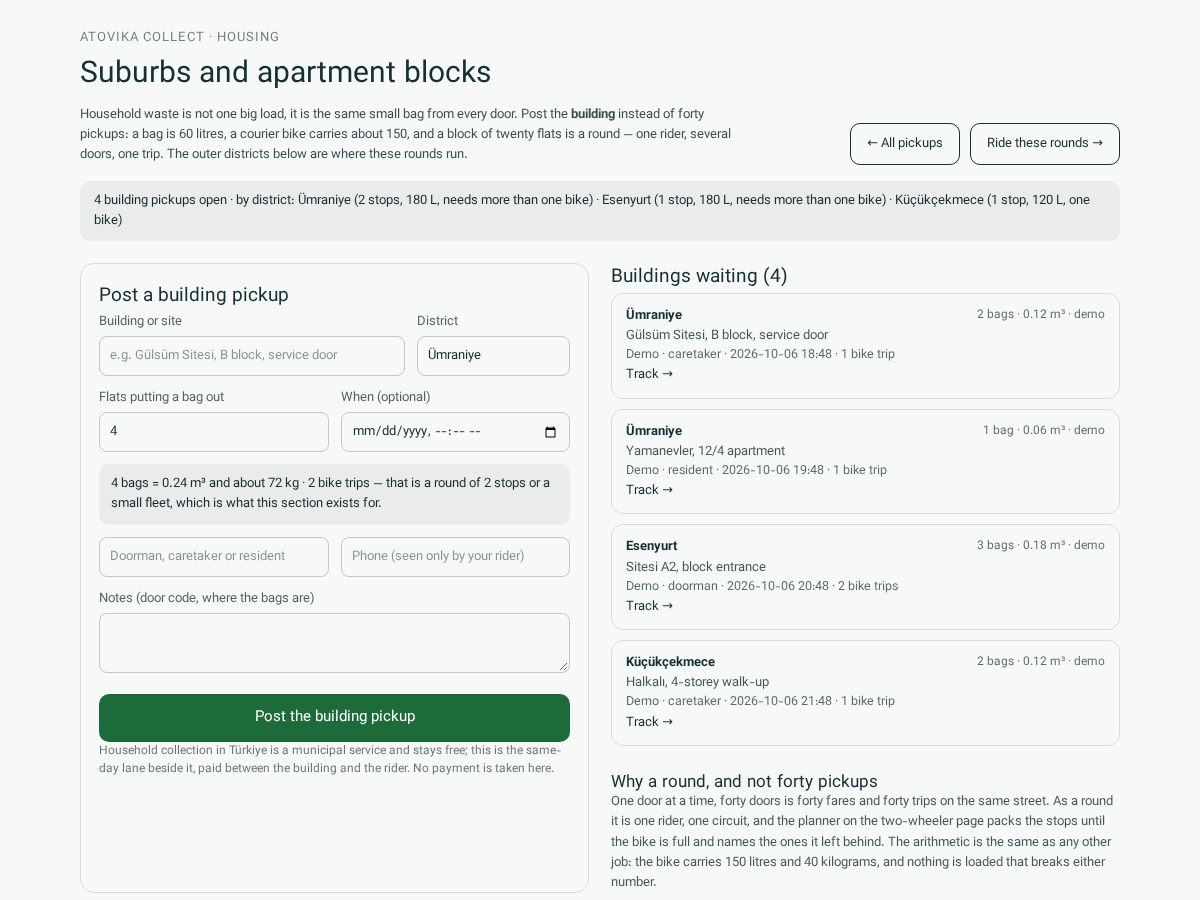 Suburbs & buildingsHousehold waste is the same small bag from every door, so the unit is the building, and the round clears it.Open the housing board
Every screen above is a screenshot of the running app, taken from the live site — not a mock-up.
Recorded from the script on this page, with a human voice, and nothing behind it but the app's own numbers. No claims beyond what the board holds.
Municipal waste collection in Türkiye is free, and slow. Atikova Collect is the paid, same-day lane beside it.
Here is how it works. A household, a shop, or a caretaker posts a pickup: what the load is, where it is, and how far it has to travel. The app answers with an estimate that states its own assumptions — base fee, distance, volume, and what the vehicle you chose can actually carry. Two vehicles, because there are two businesses here. A motorcycle courier for the small and the quick: sorted recyclables, electronic waste, a day of kitchen scraps. A van or a truck for the heavy and the bulky: a sofa, a fridge, three cubic metres of builder's rubble.
A collector registers a vehicle and sees only the jobs that vehicle can carry. Dispatch refuses impossible matches, and it says which rule refused them. Rubble on a motorcycle is refused with a reason, not a shrug: construction debris is not carried by a bike. A van that cannot lift four hundred kilograms hears exactly that number.
The motorcycle model has its own page, Atikova Moto, and two ways of working. On demand: one pickup at a time, the courier idea. Rounds: a planned circuit of doors in one district, packed per bike. The first bike takes what it can. The second opens a second load. Every stop that does not fit is refused with the number that refused it — one stop of a hundred and eighty litres does not fit a bike's hundred and fifty.
And then there is the half of the city the courier model does not fit on its own. In the outer districts, a block of flats produces the same small bag from forty doors. Sending forty bikes is not a service, it is forty trips. So the unit is the building. A doorman says how many flats put a bag out. A bag is sixty litres. A bike carries two or three. A block of twenty flats is a round — one rider, several doors, one trip.
Two operators register here, because both exist: the ordinary person with one motorbike, and the small firm with a few. A solo rider is a fleet of one.
What this is not, it says plainly. There is no payment. No live tracking. No licence or insurance check. Those are gaps you can read in the app itself, not quiet omissions.
Every number in this episode comes from the running board: the fare arithmetic, the refusal rules, the round planner. If you want to see it move, open collect.atikova.com.
No mock-ups: each card opens a part of the site that is running now.
An AI assistant that answers from a knowledge graph and cites every source. No source, no guess.
OpenThe same assistant inside Telegram, signed in with the same account.
OpenSources, organisations and waste figures, linked and searchable.
OpenA province-by-province estimate for all 81 provinces, with the method open.
OpenCompost and biogas scenarios for a site or a city.
OpenWaste and climate news from Türkiye, refreshed every six hours.
OpenFrom Istanbul’s hotels and campuses to cities everywhere, we want to make it easier to see what’s being lost — and what can be recovered. Our work connects the dots between resource efficiency and climate action.
Let’s build what’s nextA proposed four-step plan for one kitchen. Scope and cost are agreed with each site in the first conversation.
Weigh and sort the kitchen’s waste for a week before changing anything.
80-litre boxes at the source and a short briefing for kitchen staff.
Pickups planned by location and real volumes.
Weight collected, where it went, and what to cut next.
340,800 ₺
Based on the averages of 42 hotels in 15 countries: about 4 cents saved per dollar of food cost and 21% less food waste in the first year. An estimate, not a promise. Champions 12.3 · WRI & WRAP, 2018 ↗
COP31’s Green Zone is designed for climate solutions, open dialogue and new partnerships. Atikova is preparing to explore participation and share a practical vision for waste-to-value innovation.
See how an organic waste stream becomes an energy estimate in seconds.
Connect waste generators, recovery operators and climate innovators around shared action.
Explore what a measurable, local proof of concept could look like in Türkiye.
Working on circularity, recovery or climate innovation? Let’s find common ground ahead of COP31.
Whether you’re exploring a pilot, a partnership, or simply want to meet in Antalya, we’d love to hear from you.